Why should I join BPA?

Business Professionals of America sounds like the type of club your grandfather who worked in finance his whole life would join in highschool 50 years ago, but if you take a look just beyond the surface, I think you’ll come to figure out the possibilities the club holds for you and your future. Even if you are unsure of your future, the club can serve as a guide for any future endeavors towards a career or lifestyle. Take me for example, do I have any interest in a future profession in business? Nope. I’m headed for medical school, and yet joining this organization has opened a window of possibilities for me. 

Let’s start with community service and its benefits; not only does it benefit the community you serve, but it benefits you as well. Service hours are great to display on college applications, and it shows your commitment towards a cause. As well as that, they have a plethora of beneficial qualities like increasing social awareness and worldview, increasing responsibility, developing empathy and communication skills, and are even proven to help students perform better in school. 

But if that doesn’t convince you, let the skills you learn influence you. Taking part in a business-based organization like BPA allows you to learn valuable skills such as leadership, how to market yourself, fact based thinking, and a whole range of others. 

Finally, by competing in competitions and helping others, you are recognized and awarded. Plenty of recognition and awards exist within BPA to set you up for success in the future, like the BPA Merit Scholar Award, Chapter Activities Award of Excellence, and Marketing & Communications Award, just to name a few. Your good deeds and efforts can be admired locally and even nationally, which can help you prove your worth to your working society. You may be in high school, but you can always contribute to a cause, and with a cause like BPA, you wouldn’t want to miss it.


A True Epidemic

I’m sure you’ve heard of epidemics such as the Influenza virus, and a bit more recently, the Covid-19 outbreak. However, it may have never crossed your mind that an even bigger epidemic lies just beneath the surface of our society, and quite possibly our schools. While most epidemics seem to eventually lead to a cure, one in particular sticks out as a never-ending crisis; drugs. Sure, we’ve all heard it, “Drugs are bad, drugs will kill you.”, but we never truly understand the purpose of calling it an epidemic, rather than just a simple issue. 

On a grand scale, drugs killed 109,000 people in 2022, that’s more than suicide and car crashes combined. We can all remember pledging in elementary school that we wouldn’t ever do drugs, but when you take a look around you, maybe at your classmate sticking their mouth in their sleeve for a second, or the girl who just walked out of the bathroom stall coughing and rubbing her eyes, clearly any pledge we made fell through. 

You have to wonder why we ended up this way, stuck reliant on some substance that is proven to destroy our still-developing brain cells. The big question is, “What made humanity fail to protect itself?” It sounds like it should be common-sense really, saying, “No.” to drugs. The deeper meaning lies between the realms of societal norms, and well, being a kid. On one hand, you have an entire school culture feeding into this idea that, “Drugs are cool.”, and on the other hand, you have the inability of a growing mind to fully make a sound lifestyle choice. 

Since when did destroying your body, before it’s even done growing, become a trend? Drug use isn’t new, children have always been subjected to influence by their peers, it’s just simply nature. But what kids fail to recognize is that there is a life out there waiting for you beyond high school. Are the drugs going to take you to college? To a job? To a trade? Or is your ambition, your determination, or your hard work going to prove worth it and take you where you desire to be in life. 

 I am deeply saddened by the culture and norms I see in my school; the drugs that destroy any possibility of prosperity in life. So I challenge any student reading; are you going to let a substance take control of your life, or are you?

Stocks Made Simple

By Lizeht Espejo


When I asked most of my friends what a stock was, they were unsure. At that moment, I was also unsure. To me, understanding how stocks work was complicated, and it still is. I won’t exactly explain how the stock market works, but I am going to give you some small details that make stocks a lot less confusing.

            Everyone has a different understanding of “stocks” in their mind. Google defines stocks as the capital raised by a business or corporation through the issue of shares. They can also be referred to as shares, or equity. When bought, you own a percentage of the firm, and an ownership stake of its assets. To make it simpler, stocks represent ownership in a company or corporation.

The general idea of a stock is to invest in solid, well-managed companies that are capable of making profit. It is also important to remember that stocks are all about risk. Investing in the stock market can carry different types of risks, but if it is approached in an appropriate and disciplined manner, it becomes one of the most efficient ways to build up your net worth.

Now, into something that isn’t as simple: the types of stocks. After educating myself on the basic facts of stocks, I learned that there are two different types. They are known as common, and preferred. And to make life easier, they only have one major difference. A common stock carries voting rights, which allow the common shareholder to have a say in corporate meetings, while a preferred stock doesn’t. Stocks can also be classified, but I’m not going to get into that.

In conclusion, I have come to have a better understanding of what a stock is, which isn’t too hard to understand. Choosing the best stocks, and fully understanding how the stock market works will require more research from you, but hopefully you at least know what a stock is. This video helped me understand a lot more as well. >

How The Stock Exchange Works (For Dummies)

Options, Futures, and Annuities

By Avery Rathbun

Options, Futures, and Annuities


Image result for worth

What will something be worth in the future?

Prices typically change with time value. You never know if the price of something will ever go up or down in the next year. This is why Options, Futures, and Annuities are important for an investor who is trying to buy securities.

Image result for options finance

Options

If you buy an option, you have purchased the opportunity to buy something at a specific price over a period of time. The option guarantees you will be able to buy stocks from industries in the next year. If you end up choosing not to buy, you lose cost of your option but nothing else.

Image result for futures finance

                                  Futures

If you buy a futures contract, that is you saying that you will purchase 100 shares of a company’s stock for $50/share next year. Investing in futures can be dangerous because of the product ends up only being worth $10/share in the next year, you’re locked into having to pay that $50/share. Futures are risky investments.

Annuities

Image result for annuities finance

Annuities are sold by life insurance companies and provide a regular series of payments that only continue for a set period of time. An investor could either purchase annuities in a single payment or a series of payments. Annuities are most commonly used to help pay for a person’s retirement. Payments can typically increase/decrease depending on how well the investments are doing.


Is College Worth the Debt?

By Ana Deisy Calles-Zamora

Is College Worth the Debt?

Picture this, you’re 37 years old and work a full time job. You’re married and have a family of 3 kids. You come home from a long day of work and check the mail just to find your student loan bill. You’ve been paying $200 every month for the past 10+ years. Looks like that dream family vacation is going to have to be postponed another year.

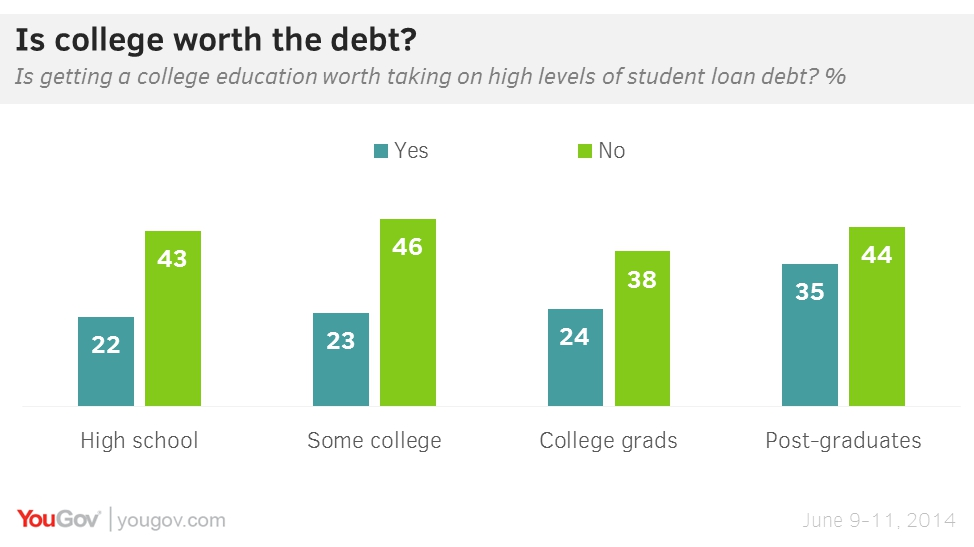
Do you think college is worth the debt? Well if you ask high school students, 43% say no. If you ask post-graduates, 44% say no as well. Wow. That is insane, right? Do you think it’s worth it?

We’ve been taught that you shouldn’t feel sorry for investing in yourself, therefore, college is a good debt. But once it makes you lose sleep at night wondering how the electric bill will get paid, can you say it is? Although the chart shown below indicates that most of people will say no, college is not worth it, you have the ultimate say in your life.

The chart above may show one thing, but a few things you need to keep in mind are, university attended, majors, living on campus or not, etc. If you want to become a doctor, you’re definitely getting yourself into smart debt. I wouldn’t even call it debt- smart investment. With the average salary of a $141,402, chances are you can pay back any school loans. If that’s the case, then college maybe is worth it for you.

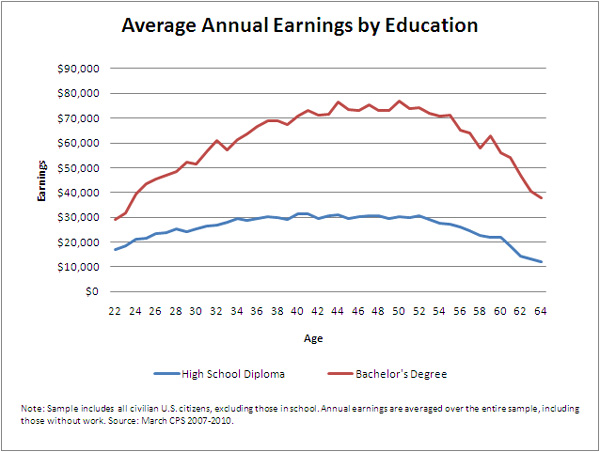
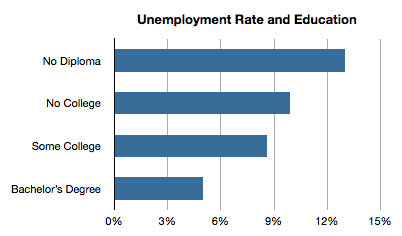
Also, those who have a higher education, than just high school have a higher salary. That may be something else you want to consider. Do you want to make $18,000-$30,000 tops? Or  do you want to make pretty money? The graph below shows the average annual earnings by education. That’s just another factor to keep in your head, when deciding if college is for you or not.

Deciding if college is for you or not, isn’t easy. We’re all different individuals and have different goals and aspirations. Whatever you want to become in life, think about the pros and cons. Do you want a job or do you want a career? Will your career pay off your loans? Do you want to work instead of college? Carefully weigh things out. Is college worth the debt? Well, the answer is up to you and your goals.

Sources:

https://www.sokanu.com/careers/doctor/salary/

What are Investment Risks?

By Robert Gonzalez

What are Investment Risks?

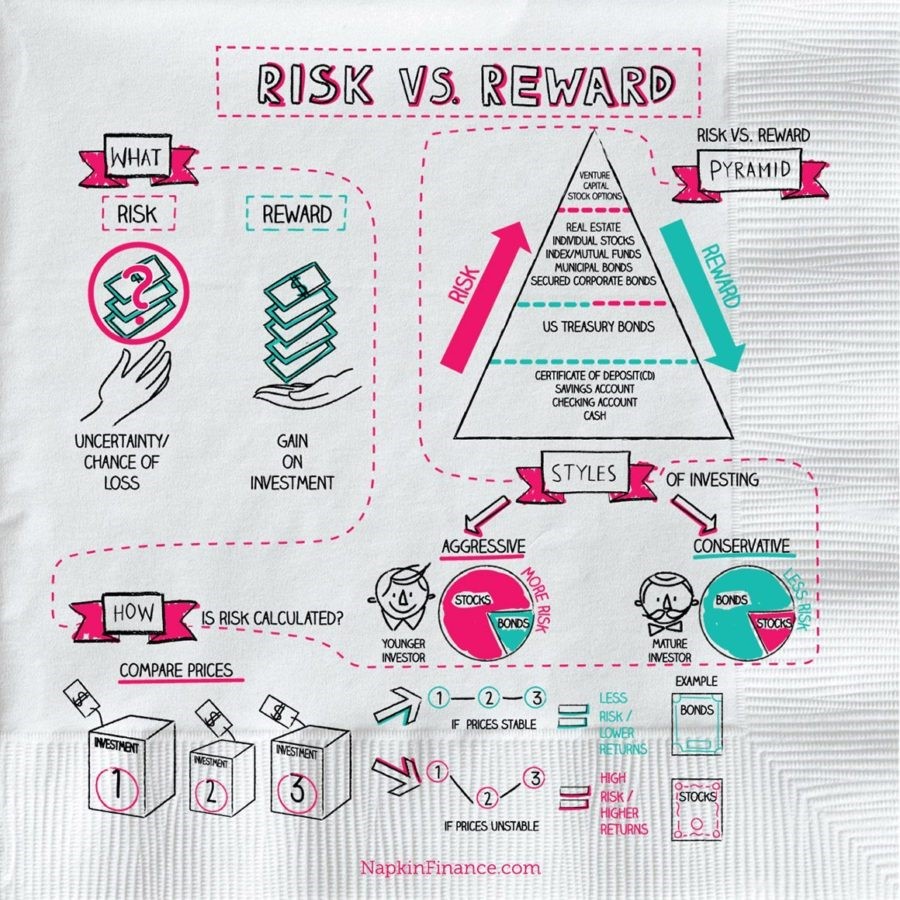
Investment Risks are the uncertainties and dangers that come with investing in certain aspects of business. There different types of investment risks, business risk, volatility risk, inflation risk, interest rate isk, and liquidity risk. While these are just a few examples there are many more types of investments that people can participate in.

How do I avoid these risks?

The size of these risks are dependent on the amount of return your investment will give you.  As shown here the more return you’re expecting to receive the higher risks that are gained with said investments. The way you can avoid having dramatic risk is by starting small when first investing. This means that before you blow all of your money investing it is smart to start with an easier and more safe type of investment such as a savings bond; a savings bond is one of, if not the most, safe type of investment because it is usually backed by the government.

How do I invest?

Depending on the type of investment you want to invest in it can be simple. To start with a simple investment, a savings bond, all you need is your IRS tax refund and you can use it to check whether or not you want to buy a savings bond with your refund. A more complicated and involved process is stock investment. To invest in stocks you need a brokerage account, put money in the account, decide how much stock you want to purchase, and your done; although, this is simplified for reader´s ease.

Sources:

https://www.investor.gov/introduction-investing/basics/what-risk

https://www.treasurydirect.gov/indiv/planning/plan_gifts.htm

Why Are Blue-Chip Stocks Beneficial to Investors?

By: Kailey Kisner

Why Are Blue-Chip Stocks Beneficial to Investors?

Related image

Blue-chip stocks are stocks of a company that is very well established and has a good rate of growth over a long period of time.  Click here to find out more about what blue-chips are and where the term came from. Out of every type of stock you could invest in blue-chip stocks have a decent rate of return between 8% and 12%.

Image result for blue chip stocks

Many people start to invest in stocks around the age of 18. At that time you don’t normally have a steady income that allows you to live on your own. Many college-aged adults are still mostly living off their parents so, the chances of them having a steady income is lower than middle-aged adults. These stocks are good for people who don’t have high risk tolerance. Risk is a very important factor when it comes to investing. Blue-chip stocks have very low risk attached to them.

Image result for blue chip stocks

For beginners, blue-chip stocks may seem like boring companies everyone knows about but, that is their benefit. For a company to have a good reputation it would have been around for a while. These are the stocks that wealthy businesses invest in. Stock markets crash and when they do your holdings will drop but, blue-chips tend to fall less due to yield support. To learn more about wealthy businesses and why they invest in blue-chip stocks click here.

Image result for blue-chip companies

Blue-chip stocks have low risk, a decent rate of return, and are good for both beginners and wealthy businesses. That is their benefit to investors. Some companies considered blue-chips are: The Coca-Cola Company, Johnson and Johnson, and Chevron. These are big names that have been around for a while. They will continue to be around for years to come. So, you can invest in these companies anytime. For more information click the link below.

WHAT IS A BLUE CHIP STOCK? (Dividend Stocks & Income Investments)  

What to Consider When Determining Your Risk Tolerance

By Martina Rexrode

Image from: Lynda.com

What to Consider When Determining Your Risk Tolerance

Before you dive into a major financial decision, consider the weight of your risks vs. rewards. This simple equation can assist in decisions of all kinds, especially because risk tolerance can be a particularly personal thing.

Depending on factors including your age and current financial situation, you could be more comfortable with taking risks if you are in your 20s with decades longer to stop and start over again than if you are approaching your late 40s or 50s. A younger adult in their college years up through their early 50s has a safe amount of time until they will need the money for retirement or any health emergencies that might come up. This concept of thinking is referred to as a “time horizon”. Time horizons put into perspective the amount of risk that would be most comfortable for specific age groups based on their years until retirement.

Another factor to consider when determining risk tolerance is your risk capital. Risk capital is described as the amount of money you have available to invest or trade that will not directly affect your personal life if it was lost. In simpler terms, this means that if you enter an investment with little capital, it will take much longer to recover from a loss than if you had gone into it with moderate or excess capital.

Risk tolerance varies from person to person, so yours will most likely be significantly different from that of your peers. Don’t let others influence your level of risk taking. Before you are set on a decision, first allow yourself to compare the pros and cons of your planned investment. Frontier Wealth Management suggests that you ask yourself three things: when you will need the money you’re going to invest, how emotionally prepared you are to handle a high level of risk followed by high stress, and what other assets you possess to fall back on if an investment goes south.

If you’re going to take away anything from my words, let it be this: Don’t go in without a plan.

For more information on risk tolerance, check out this short video: https://youtu.be/mfeqH92z9Ic

Economic Risk and Its Effects on Your Economic Choices.

By: John Martin

Whether you realize it or not, risk tolerance has a huge factor in every financial decision you make. This is because every choice you make has some level of risk. Which is made up of risk appetite, tolerance, and capacity. Risk appetite is how much risk you need to take. Ri

sk tolerance itself is how much risk you prefer to take. Lastly, risk capacity is how much risk you can afford.

All of those factors contribute to your economic choices. From buying a candy bar isn’t risky as it is inexpensive and $1 is easy to earn back so the risk capacity is high. To purchasing stock, Which is is more risking as risk capacity varies depending on if you can afford losing some money in the stock market, risk appetite is normally low as people don’t “need” stock. Both of these purchases are very very different. As getting a candy bar is far less expensive than buying stock. But, both are made due to your economic risk, no matter how high or low the risk is.

Image result for risk appetite and tolerance

Also if your risk is low, you would want a account where you don’t risk losing money or making purchases you can’t afford. So you would want savings account along with a debit card, as a debit card limits you to just the money you have and it stops you from making purchases you can’t afford. Whereas most people have a moderate level of economic risk and use a checkings account with a credit card because their risk tolerance it a bit higher and their risk capacity is higher due to the fact they have a stable job that they can afford to pay back a purchase over time, if they don’t have money for the full purchase at the time or want to pay thousands of dollars at the moment for a new car. No matter what you go and purchase next, take a quick second and think about the risk there is in making the purchase.

https://www.investor.gov/research-before-you-invest/research/assessing-your-risk-tolerance

Savings Accounts, What’s Right For You?

By Lanaya Haynes

What is a saving account?

          A savings account is an interest-bearing account that allows you to safely save your money while earning a moderate interest rate. Also, they are insured by the Federal Deposit Insurance Corporation (FDIC) up to $250,000 per account.

What are the different types of savings accounts?

  1. Savings Deposit Accounts – Earns interest and allows you to withdraw money at any time with a limit of six transfers per month.
  • Jumbo Savings Accounts – Same as savings deposit accounts but has deposits of $100,000 or more. The account may pay a higher interest rate on such large deposits.
  • High Interest Savings Accounts – Has a higher minimum balance which in turn produces higher interest rates.
  • Rewards Savings Accounts – Offer special incentives when opening accounts or reaching specific balance levels.
  • Joint Savings Accounts – Savings account that is shared between two or more people. One advantage is that the FDIC ensures the number of owners on the account times the $250,000 insurance limit.
  • Student Savings Accounts – Accounts that are offered to high school or college students usually with flexible terms such as lower minimum balance requirements.
  • Certificates of Deposit (CD) – Accounts that require you to keep your savings in the account without touching it for a fixed period. Because of this, CD’s typically offer higher interest rate but if you withdraw before to allotted time you may have to pay a penalty.

There are still many more different accounts mostly those that are beneficial for special circumstances. These include college savings accounts (529 plans), individual retirement arrangements (IRA’s), roth IRA, 401(k) retirement plans, and health savings accounts (HSA’s).

Summary

All in all, there are many different types of savings accounts that can accommodate everyone’s needs. Whether you can have maintain a high minimum balance or a low minimum balance, have money to put away and not touch for a fixed period, or even want to save at a young age, savings accounts provide it all.

https://www.money-rates.com/basicguides/saving/types-of-savings-accounts.html

https://www.investopedia.com/terms/s/savingsaccount.asphttps://www.nerdwallet.com/blog/banking/savings-accounts-basics/